
INSiGHT Scans
In this day and age, technology has become an integral part of our daily lives. From smart watches that track our steps, Apps that track our sleep cycles and nutritional habits – we are a society that loves measuring and tracking our progress.
This is the same for our office. We are absolutely in love with objective tracking measures that assess what is going on with your central nervous system, and how your body is functioning.
Our INSiGHT scans do just that.
There are 3 scans we can assess to help gain a better understanding of what is happening with your nervous system. These provide us with more details about you or your child’s health and they help us individualize location and frequency of care.
The first scan is the Neuro Thermal scan. We can run this scan on anyone and everyone as it is non-invasive and is looking at thermo regulation along the spine. So whether you are 1 hour old, to 100 years old, or even pregnant – this scan will help us to locate and quantify the stress and overwhelm the nervous system
This scan looks at the function of the autonomic nervous system. This branch of the central nervous system that controls and regulates things like digestion, sleep patterns, immune function, organ function, hormones, it’s involved in sensory challenges, autism, ADHD, and so many other things that we as parents, have concerns with.
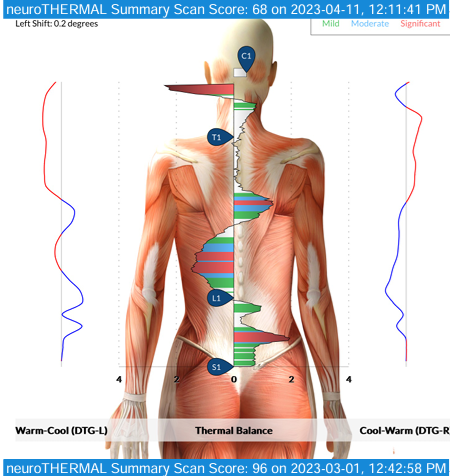
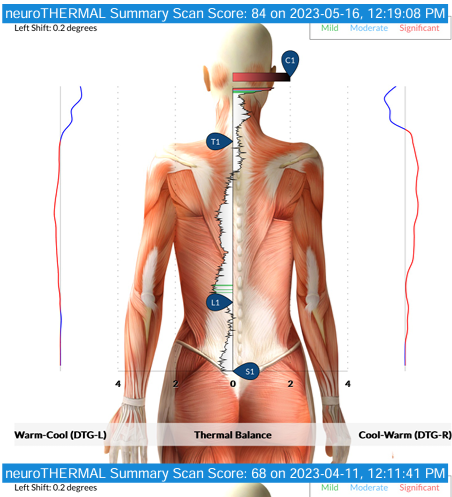
These scans will be explained to you more on your one on one visit, but there are some general aspects we can discuss here.
Green, blue, and red bars on the top half NCM graph– indicates that stuck, tension, and sympathetic (stress) dominance
Tons of ‘back and forth’ or ‘tug of war’ type tracking – this indicates dysautonomia and tension throughout the neurospinal system. (especially seen in the initial scan in the upper neck).
The 2 lines along the sides of the graph are inside the black lines and blue – this indicates the subluxation and condition are becoming more chronic.
The next scan also assesses the function of the autonomic nervous system by means of Heart Rate Variability (AKA HRV). This test is certainly gaining popularity and many new smart watches have this measurement available – which is an awesome tool! Our test gets more into the specifics and details of how this is all functioning.
Overall, HRV gives us a big picture analysis of the nervous system. Good neurological health requires variability – meaning it has good adaptability and resilience to respond and endure the stressors of everyday life.
The benefit of this test is to show the tone and balance of your nervous system, whether it is in a state of constant stress mode, or more in an exhausted state. A great analogy for this test is it measures how strong your gas pedal is (your stress mode), and how well your breaks work to match (parasympathetic, rest/digest/heal/connect mode).
Just like a safe car requires a properly functioning gas and break pedal, our nervous system requires this as well. Where this is relevant is the fact that life is going to throw us challenges. We will always be exposed to toxins, viruses/bacterias, emotional and physical stressors. These in themselves are not the problem, in fact a healthy response to stress can strengthen us, motivate us and make us better!
Where it can become a problem is if our body is not able to adapt and respond to life, making us prone to illness, burnout, symptoms, etc.
The key to good health is being adaptable and resilient to withstand life’s demands, rather than try to place your kids or yourself in a bubble.
This is a typical scan we see at the office.
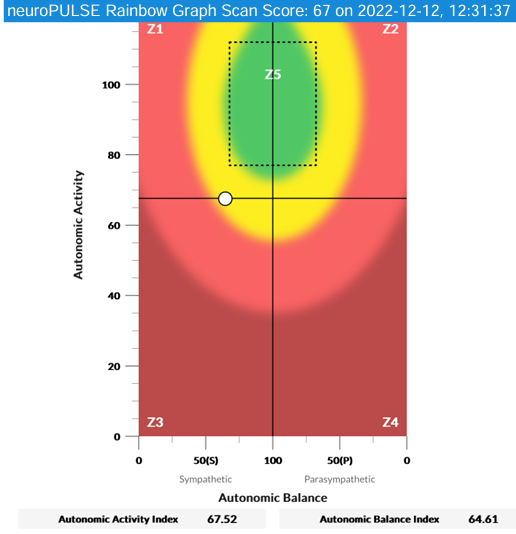
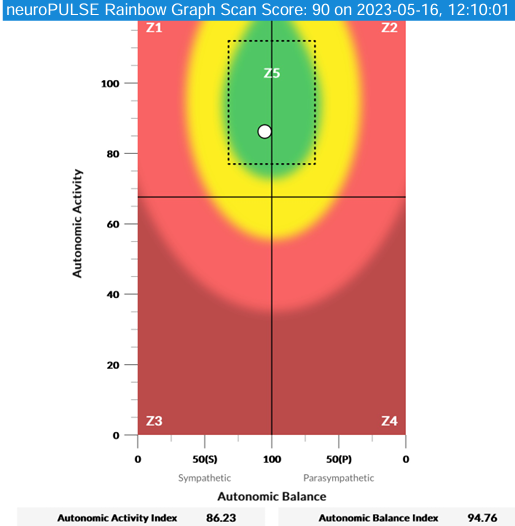
The patient’s score is the white dot you see on the colour spectrum.
Shifted left – meaning the patient is stuck predominantly in sympathetic fight-or-flight mode and/or has an exhausted parasympathetic nervous system and vagal tone issues
Shifted low – indicating the patient has lower ‘reserve capacity’ and adaptability, or “low energy”
There are many benefits to tracking this test over time. Poor vagal tone relates to so many challenges in the kids we get to care for at the office. From emotional regulation, immune challenges, to their ability to focus and learn – HRV gives you a window into their nervous systems to help explain their full clinical picture, beyond the symptoms.
The final neurological scan we do is called the NeuroSpinal EMG
This scan measures the effects of stress on the neuromuscular system. This test is so telling in our “Perfect Storm” cases where kids have been diagnosed with conditions such as Autism, ADHD, Sensory processing, and anxiety. These conditions are so related to altered neuromotor tone.
When there is stress, subluxation and poor adaptation related to motor tone, it impacts the brain and can challenge higher brain functions such as emotional regulation, attention span, therefore learning and memory.
These scans will also be described in more detail with your doctor, but in as a general read, there are 3 important scores to pay attention to.
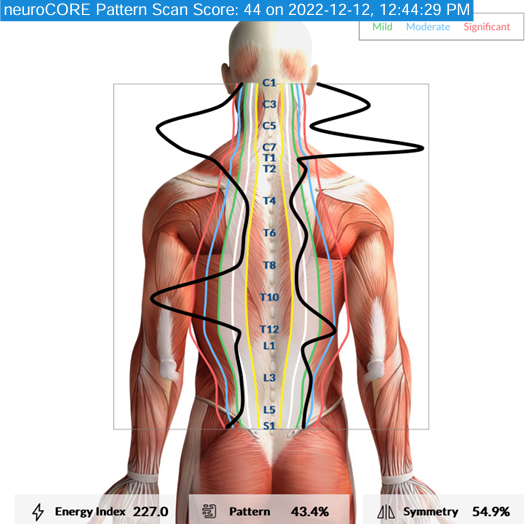
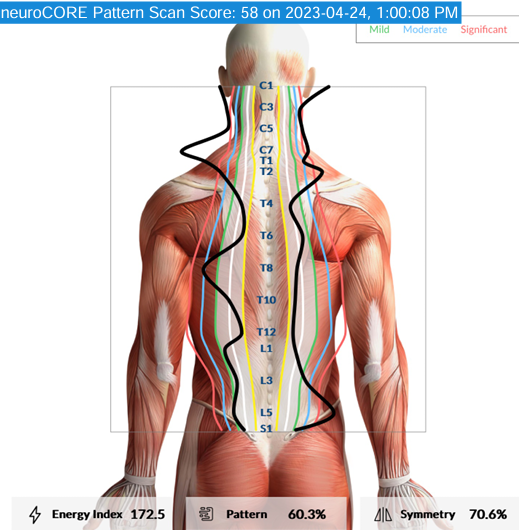
Total Energy Score – this score tends to go way up in a child who’s wound up and stuck in sympathetic mode, and therefore a high score here is most often seen with our ‘Raging Bull’ cases struggling with things like anxiety, behavior and sleep issues, and so forth. A “normal” score should be at 100-120.
Pattern Score – this is a significant score to the overall neurological tone, and a low score here indicates a child who’s likely struggling with emotional dysregulation, focus and concentration challenges, postural exhaustion and a weak core, and so forth
Symmetry Score – this score measures the balance between the right and left sides of the neurospinal system, which is crucial to be then sure that there is balance in overall brain function and coordination
These scans provide us with more detail with regards to the function of your child’s nervous system to help us better care for them. Again, watching the patterns change throughout care provides us with a deeper understanding, rather than using symptoms alone.
If you are looking to help your child improve with anything related to the nervous system, testing the function of the nervous system just makes sense. Having an objective measure of the stress will help us individualize care and help get them the best results. Contact us today to have your child’s scan done so we can help identify the root cause and get your child back on track .